What is forex and how do beginners actually start trading it without blowing up an account?
You can order the same kind of articles for your own video to boost it on YouTube and Google. Just message the Telegram bot @sat_sit_bot. Articles with your video embedded are written and posted by the bot itself — on popular topical sites (no ads). Try it free: 50 articles on us.
· based on the channel JeaFx
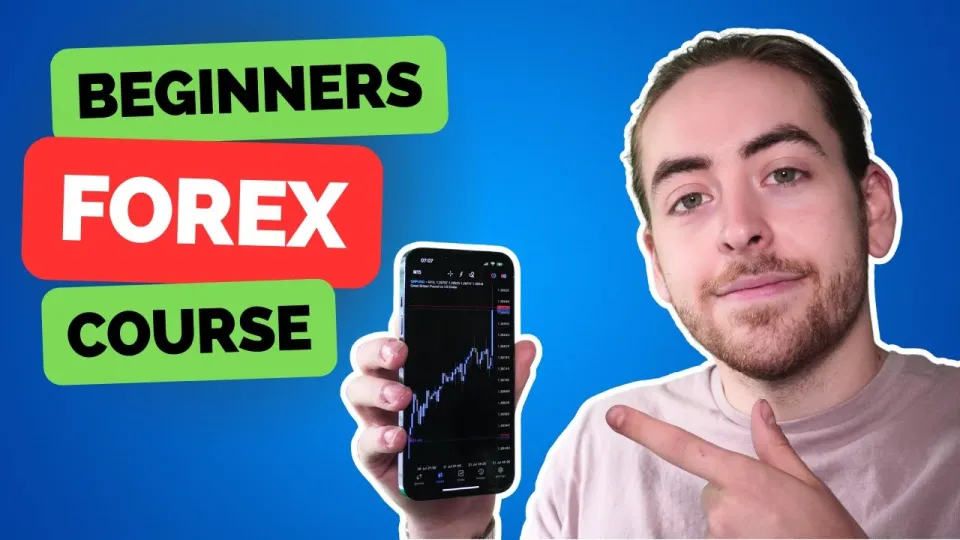
Forex is the global market where one currency is exchanged for another, quoted in pairs like EUR/USD, and beginners start by learning what is actually traded, how profit is generated, how a broker account works and how to build a repeatable edge before risking real money. The full beginner course from JeaFx walks through exactly that order, and the free class behind the JeaFx training page is built for traders who want the fundamentals explained before they fund an account.
What is forex and what is actually traded
Forex is a decentralised, over-the-counter market where national currencies are priced against each other in pairs, and everything a beginner trades is a derivative of that exchange rate. There is no central exchange and no physical delivery for retail traders: you buy or sell a currency pair through a broker, and your profit or loss is the difference between the entry and exit price.
The main instruments you will meet:
- Majors — EUR/USD, GBP/USD, USD/JPY, USD/CHF, AUD/USD, USD/CAD. Tightest spreads, deepest liquidity, most analysis available.
- Minors and crosses — pairs without the US dollar, such as EUR/GBP or GBP/JPY. Wider spreads, sharper moves.
- Exotics — USD/TRY, USD/ZAR, USD/MXN. Thin liquidity and political risk; not a beginner's market.
- Metals and indices offered by forex brokers — gold (XAU/USD) is the most common add-on, but it is not a currency pair and behaves differently.
Each pair has a base currency (the first symbol) and a quote currency (the second). In EUR/USD at 1.0850, one euro costs 1.0850 US dollars. A standard lot is 100,000 units of the base currency, a mini lot is 10,000 and a micro lot is 1,000 — the lot size is what converts a price move into money.
How money is actually made in forex
Money in forex is made from the change in a pair's exchange rate multiplied by your position size, and that is the only source of trading profit. If you buy EUR/USD at 1.0850 and close at 1.0900, the 50-pip move is worth $50 on a mini lot (10,000 units) and $5 on a micro lot (1,000 units).
Three mechanics decide the size of that result:
- Direction — long if you expect the base currency to strengthen, short if you expect it to weaken. Shorting is as normal as buying.
- Position size — the same 50-pip move pays 10 times more on a mini lot than on a micro lot, and loses 10 times more if you are wrong.
- Leverage — a broker might offer 1:30, 1:100 or more. Leverage does not create profit; it lowers the margin required to hold a position and magnifies the effect of position size on your equity.
Costs sit on top: the spread (the gap between bid and ask), commission on raw-spread accounts, and swap, the overnight financing charge for holding a position past the daily rollover. A strategy that ignores costs can look profitable in theory and lose in practice.
Setting up a broker and a trading account
A broker is the intermediary that gives you access to the currency market, so the selection criteria are regulation, cost and reliability rather than marketing. Check that the entity is supervised by a recognised regulator, that client funds are segregated, and that withdrawals have a documented process and a track record you can verify.
A practical setup sequence:
- Verify the licence — find the regulator's public register and confirm the legal entity name on the broker's client agreement.
- Compare costs — spread plus commission per lot, swap rates, and any inactivity or withdrawal fees.
- Choose an account type — standard or raw-spread, and confirm the minimum deposit and lot step size (0.01 lots matters for small accounts).
- Open a demo first — same platform, same instruments, so you can test execution and your own plan without capital at risk.
- Fund small and withdraw early — a modest first deposit plus one successful withdrawal test tells you more about a broker than any review.
On the platform side, learn four things before anything else: how to place a market and pending order, how to set a stop loss and take profit, how to read the contract specification of a pair, and how to calculate position size from your risk in money.
Building a market edge as a beginner
An edge is a repeatable reason why your winners outweigh your losers after costs, and beginners build it from a written process rather than from a favourite indicator. Price action — structure, support and resistance, liquidity and session behaviour — is the common starting point because it is observable and testable.
The workflow that produces an edge:
- Pick one market and one timeframe — for example EUR/USD on the 1-hour chart with a 4-hour bias.
- Define the setup in writing — entry trigger, invalidation level, target logic, and the sessions in which the setup is valid (London and New York overlap carries the deepest liquidity).
- Backtest by hand — replay at least 100 historical setups, record every one, and compute win rate, average win, average loss and expectancy.
- Forward test on demo — confirm the results hold with live spreads and real execution.
- Go live at minimum size — micro lots until the process is boring and consistent.
Risk management is part of the edge, not an accessory. A common framework caps risk at about 1% of equity per trade, sets a daily drawdown limit, and sizes every position from the stop distance so that a losing streak is survivable. A journal with screenshots, the reason for entry, and the outcome turns experience into data.
Mindset and realistic expectations
Trading rewards patience and process discipline, and beginners lose money mainly because they size too big, abandon the plan after two losses and treat the account like a casino. A $500 account risking 1% puts $5 at stake per trade — that is the honest scale of early trading, and it is the correct one.
Expectations worth setting before the first live trade:
- The first months are for proving a process, not for income.
- Losing trades are a normal cost of doing business; a strategy can win 40% of the time and still be profitable if the average win is large enough.
- Social media screenshots of fast account growth are not a benchmark, and neither are the claims in comment sections.
- Screens, sleep and emotion interact: a written checklist protects you on days when judgement is poor.
Common beginner questions and doubts
Most beginner doubts repeat across every comment thread, and they usually come down to capital, time and trust. Traders ask whether a small account can work at all, whether a course replaces practice, and how long it takes before results appear.
- "Can I start with a few hundred dollars?" Yes, with micro lots and strict percentage risk. What a small account cannot do is fund a lifestyle, so treat it as tuition for execution.
- "How long until I am profitable?" There is no fixed number. Hand-testing 100 setups plus a demo phase typically takes months, and consistency is judged over a sample of trades, not a week.
- "Do I need a mentor or a paid course?" Structure shortens the learning curve, but no course removes the need for screen time and a journal. Free fundamentals plus disciplined backtesting cover a lot of ground.
- "Why do so many beginners fail?" Oversized positions, no stop loss, no records and no defined setup. Fix those four and the failure rate changes.
Useful links
- Free JeaFx class on why traders lose and what to fix: https://jeafx.com/class
- Guided mentorship programme: https://jeafx.com/go
- Instagram: https://www.instagram.com/jeafx_
- Free Telegram community: https://t.me/therealjeafx
Final takeaway
Forex is a leveraged, decentralised currency market where profit comes from exchange-rate moves sized by your position, so the beginner's real job is risk control and repetition, not prediction. Learn what is traded, understand how lot size turns pips into money, choose a regulated broker, then build and test one written setup before going live at micro size. The JeaFx full beginner course lays out this sequence in order, and its free class is the natural next step for anyone who wants the fundamentals plus a framework for why traders lose. Treat the first year as an apprenticeship with records, and the market will eventually pay for the skill you built.
Key takeaways
- Forex is an over-the-counter market where currencies are quoted in pairs such as EUR/USD, and profit comes from the change in the exchange rate, not from owning the currency.
- Retail traders usually access forex through a broker offering leverage; a $500 account with 1:100 leverage controls $50,000 of notional value, which is why risk per trade matters more than account size.
- A working beginner framework limits risk to roughly 1% of the account per trade, tracks a daily drawdown cap and journals every setup.
- Broker choice rests on regulation, spreads and commission, execution quality and withdrawal reliability, not on bonuses or account-opening gifts.
- Most beginner losses come from oversized positions, no written plan and treating trading as a casino rather than a business with records.
Questions & answers
How much money do I need to start trading forex?
You can open many accounts with a few hundred dollars, and micro lots let you risk a small fixed percentage per trade. The constraint is not the minimum deposit but position sizing: with $500 and 1% risk, each trade puts about $5 at stake, so the account is for learning execution rather than income.
Is forex trading gambling?
It becomes gambling when positions are sized without a stop, without a tested setup and without records. Trading with a defined entry, invalidation level, target and a capped risk per trade is a probabilistic business, and the difference shows up in the journal.
How long does it take to become consistently profitable?
There is no universal timeline, but a realistic path includes hand-backtesting at least 100 setups, a demo phase with live spreads, and then micro-lot live trading. Consistency is measured over a sample of dozens of trades, so plan in months rather than weeks.
Do I need a mentor or a paid course to learn forex?
Not strictly, but structure shortens the trial-and-error phase. A course or mentor helps most with process, risk rules and review of your trades; screen time, backtesting and journaling are still yours to do, and no programme replaces them.
Source: Forex Trading For Beginners (FULL COURSE) · Markdown version